
Table of Contents
- Why Open Water Demands Different Sunglasses
- Quick Comparison: What Matters Most for Open Water
- Best Lens Tints for Water Sports and Glare Control
- Hydrophobic Coating for Sports Eyewear: Why It Matters on the Water
- How to Prevent Fogging on Prescription Sports Glasses
- Fit, Grip and Prescription Limits for Open Water Sunglasses
- Common Mistakes When Buying Prescription Sunglasses for Open Water
- Conclusion
- Frequently Asked Questions
Last Updated: 17 September 2026
Why Open Water Demands Different Sunglasses
Open water swimming punishes ordinary sunglasses in ways a pool or a pavement never will. Salt, spray, glare bouncing off moving water, and a horizon that shifts with every stroke all conspire against frames designed for the high street. This guide from Echelon Eyewear explains how to choose prescription sports sunglasses for open water that stay put, cut glare properly, and hold their clarity over long distances.
The core problem is simple: flat water reflects light straight back at your eyes from a constantly changing angle. A tint that works on a road ride can leave you squinting into a bright sheet of reflection mid-lake. Add a prescription, and you also have to balance optical accuracy against the wrap and curvature that keep water out.
Most guides treat this as a fashion decision. It isn’t. It’s an optical and fit problem, and getting it wrong means fogged lenses, slipping frames, and eye strain exactly when you need to sight a buoy.
Quick Comparison: What Matters Most for Open Water
Five factors decide whether a pair works on the water, and they matter more than brand or price. The table below summarises what to prioritise and why.
| Factor | What to Look For | Why It Matters on Water |
|---|---|---|
| Lens tint | Copper, brown or grey base | Cuts reflected glare without dulling contrast |
| Coating | Hydrophobic and anti-fog | Sheds water, resists misting |
| Fit | Wraparound with grip temples | Stops slip and reduces wind and spray |
| Prescription | Within frame’s power range | Keeps optics accurate across the curve |
| Coverage | Full eye and brow protection | Blocks low-angle reflected light |
If you remember nothing else, remember this: tint and coating do the optical work, but fit is what keeps them on your face for a two-hour swim. Get the fit wrong and everything else is wasted.
Best Lens Tints for Water Sports and Glare Control
For open water, the best lens tints for water sports are copper, brown, and grey base colours, because they reduce the intensity of reflected light while preserving contrast against a bright horizon. Copper and brown warm up the view and sharpen definition; grey keeps colours neutral and cuts overall brightness without distortion.
What most swimmers get wrong is reaching for the darkest lens available. Darkness alone doesn’t stop glare, it just makes everything dimmer, including the buoy you’re trying to spot. The tint’s colour and its ability to filter reflected light matter more than how black it looks.
Polarised lenses are worth considering for flat, calm water, where reflection is strongest. The trade-off is that polarisation can make some digital displays and certain surface details harder to read, so it suits open water better than it suits a pool with lane clocks. If you swim in mixed conditions, a photochromic lens that adjusts to changing light is a sensible middle ground.
Ask for a lens that filters blue light specifically. Blue wavelengths scatter most in water spray, which is why a copper or brown base feels calmer on the eyes than a neutral grey on a bright day.
Hydrophobic Coating for Sports Eyewear: Why It Matters on the Water
A hydrophobic coating for sports eyewear is a surface treatment that repels water so droplets bead and roll off instead of smearing across the lens. On open water, that difference is the gap between clear sight lines and a film of spray blurring every stroke.
Without it, water clings in sheets. You tilt your head, the water spreads, and suddenly you’re sighting a buoy through a distorted lens. A hydrophobic layer forces droplets to bead, so a quick head turn sheds them. Pair it with an anti-fog inner coating and you cover both problems: water on the outside, condensation on the inside.
The coating is also what protects the lens surface from salt and chlorine over time. Salt crystals are abrasive, and wiping a gritty lens with a towel scratches the coating and the lens beneath it. Rinse in fresh water after every swim and let the frames air dry.
guidance on protecting your eyes from UV and glare
How to Prevent Fogging on Prescription Sports Glasses
To prevent fogging on prescription sports glasses, control the temperature gap between your face and the air, and use an anti-fog coating on the inner lens. Fog forms when warm, moist air from your skin meets a cooler lens surface. In open water, that happens every time you stop moving or turn into a cold wind.
Four habits keep lenses clear:
- Choose frames with vented lenses or an airflow gap at the top edge
- Fit the frame so it sits close but doesn’t seal against your brow
- Use an anti-fog treated lens rather than a bare prescription lens
- Avoid touching the inner lens, since skin oils break down the coating
A common mistake is wiping a fogged lens with a dry cloth. That smears the moisture and strips the coating faster. Let the lens clear on its own or rinse it and shake it dry.
Never clean a coated sports lens with a dry paper towel or your rash vest. The grit in the fabric scratches the hydrophobic layer, and once it’s gone, water clings and glare returns.
Fit, Grip and Prescription Limits for Open Water Sunglasses
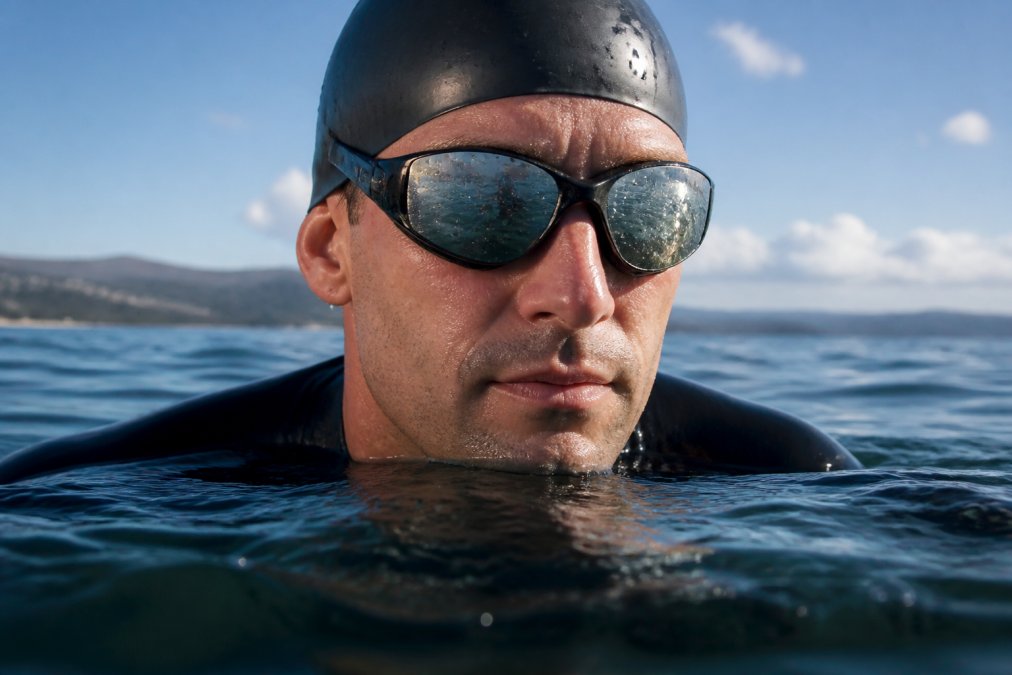
Fit is the deciding factor for prescription sports sunglasses for open water, because a frame that shifts mid-stroke ruins both your sight line and your focus. Look for wraparound shapes with rubberised nose pads and grip temples that hold firmer as you sweat, rather than loosening.
Prescription limits matter just as much. A high wrap curve changes how light enters the lens, and strong prescriptions can distort at the edges of a curved frame. That’s why a good supplier checks your prescription against the frame’s supported power range before ordering, and may recommend a flatter base curve or a smaller lens for stronger prescriptions. The goal is a wide field of view without heavy, thick lenses that pull the frame forward.
Adjustable nose pieces and temple tips make a real difference for anyone whose face doesn’t suit an off-the-shelf fit. Echelon Eyewear stocks performance frames with these adjustment points.
Common Mistakes When Buying Prescription Sunglasses for Open Water
The most expensive mistake is buying on looks and tint alone, then discovering the frame slips or the prescription distorts at the edges. Four more to avoid:
- Choosing the darkest lens rather than the right tint for reflected glare
- Skipping hydrophobic and anti-fog coatings to save a little
- Ordering a strong prescription in a heavily curved frame without checking limits
- Ignoring nose and temple adjustment, then blaming the frame when it moves
A second common trap is buying a general-purpose pair and expecting it to handle open water, chlorine, and salt. Each of those stresses the frame differently, and a lens that resists one may struggle with another.
Spend your budget in this order: fit first, then tint, then coatings, then style. A well-fitted frame with a mid-range tint will outperform a poorly fitted premium pair every time you swim.
Conclusion
Getting the right prescription sports sunglasses for open water comes down to fit, tint, and coatings working together, and that balance is hard to judge from a product photo alone. Echelon Eyewear specialises in prescription sports eyewear for swimmers and other athletes, offering performance frames from leading brands and sports-specific collections. If you want frames that stay put, cut glare, and hold their clarity stroke after stroke, get started with Echelon Eyewear and shop the open water range today.
Frequently Asked Questions
Can you get prescription sunglasses for open water swimming?
Yes. Wraparound and shield-style sports frames can be glazed with your prescription, though very strong prescriptions may need a higher base curve or a slightly thicker lens. Brands such as Bolle, adidas and POC offer sports models that accept prescription inserts or direct glazing. Ask your optician for your pupillary distance and prescription details before ordering, and check that the frame you choose supports your specific prescription range.
What lens tint is best for open water sports?
Grey and brown tints work well for bright, exposed water because they cut overall glare without distorting colour. Copper or rose tints boost contrast on overcast days, which helps you spot buoys and other swimmers. For sailing and paddling, a polarised grey lens reduces reflected glare from the water surface. If conditions change often, a photochromic lens that darkens in sunlight gives you one pair for the whole session.
Do I need polarised lenses for open water activities?
Polarised lenses cut horizontal glare bouncing off water, which helps with sailing, paddling and fishing. However, some open water swimmers prefer non-polarised lenses because polarisation can make it harder to read certain digital displays or gauge depth. If you swim in a pool with lane markings or use a watch with an LCD screen, test polarised lenses first. For most recreational open water use, polarised grey or brown lenses are a solid choice.
How do I stop my prescription sports sunglasses from fogging up?
Anti-fog coatings on the inner lens surface are the first line of defence. Look for frames with vented lenses or adjustable nose bridges that let air circulate behind the lens. Cleaning with a hydrophobic coating for sports eyewear also helps, because it stops water and sweat from clinging. Avoid wiping lenses with your fingers or a rough cloth, as this strips the coating. A quick rinse in fresh water after swimming and a microfibre dry keeps the coating working longer.