
Shopping for sunglasses these days can be a little overwhelming if you’re not clued up on the latest sunglasses jargon.
Words like photochromic, Trivex, and oleophobic coating don’t mean much to most people. But if you’re determined to pick up the perfect pair of sunglasses, then here’s everything you need to know.
Lens technology & materials
CR39
CR39 lenses are plastic lenses used in sunglasses and prescription glasses. Known for being lightweight and impact-resistant, they are an affordable option for those looking for robust glasses.
Polycarbonate
With great impact resistance and UV protection, polycarbonate lenses are a popular choice for sports sunglasses, safety glasses and children’s glasses. They’re thinner and lighter in weight than traditional glass too.
However, their resistance to abrasion is typically poor, meaning that an anti-scratch coating is worth pairing with polycarbonate lenses.
Trivex
Trivex is another lightweight plastic that’s growing in popularity alongside polycarbonate lenses. Originally designed for military use, Trivex is one of the most durable materials for glasses and sunglasses.
Compared to its popular counterpart, polycarbonate, Trivex is often lighter, more scratch-resistant, and enables clearer vision thanks to its higher abbe value.
Mineral glass
While less common than other materials on the list, mineral glass is one that offers the best optical clarity of lens materials. It’s a robust material that’s ideal for different sports. However, it’s sometimes heavier and more expensive than other lens types.
Mirrored lenses
Primarily chosen for their style, mirrored lenses do still offer protection from bright sunlight and harmful UV rays. By naturally reducing light from getting to your eyes, they offer great glare protection with a degree of privacy thanks to the mirrored exterior.
Polarised lenses
Polarised lenses were designed to dramatically reduce glare in your surroundings. You may not notice how much glare you’re dealing with on a daily basis. The sunlight bounces off flat surfaces like roads, pavements, water, snow, and even grass.
Putting on a pair of polarised lenses reduces glare that’s distracting and can interfere with clear vision – making it a favourite for sports enthusiasts.
Not sure if you need polarised lenses, read our article: Polarised vs Non-Polarised Sunglasses: Which is Best?
Photochromic lenses
Also sometimes called transition lenses, this technology changes the tint according to the light around you. So, if it’s sunny, they’ll darken. If you head inside, they’ll go clear.
The biggest pro of this is that you only need one pair of glasses if you wear prescription lenses usually.
Sunglasses frames
TR-90
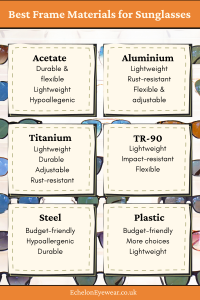
TR-90 is a thermoplastic material that offers good durability and is versatile enough to make different sunglasses designs.
Acetate
After being developed in the 1940s, acetate was used for its durability and flexibility. It’s a plant-based type of plastic made from natural cotton and wood, which makes surprisingly strong sunglasses frames.
Learn more about how sunglasses frame materials stand up in our full article, What’s the Best Sunglasses Frame Material?
Lens coatings
Aside from the material of the lenses, additional coating applied to the lens itself can also enhance comfort, vision, and practicality.
Hydrophobic coating
This is a water repellent treatment that causes water to roll off the lens quickly. So if you’re caught out going for a jog in a sudden downpour, you can still see clearly.
Hydrophobic treatments are also handy for reducing anything else from fingerprints to sweat from sticking to your lenses.
Oleophobic coating
An oleophobic coating helps to protect lenses from smudges and fingerprints. This makes your glasses much easier to clean when you’re on the go.
Anti-fog coating
An anti-fog coating works by absorbing and repelling moisture on the surface of the lens. Fogging lenses are a pet peeve for athletes who wear face masks, work in more extreme temperatures, or find their glasses steaming up during intense exercise. Some sunglasses will come with built-in coatings or ventilation to prevent this, but it can also be applied as a spray to glasses.
Anti-scratch coating
A scratch-resistant coating is a hard layer applied to the lens surface to strengthen it and keep the glasses protected for much longer. An anti-scratch coating is highly recommended for softer lens types like plastic, CR39, and polycarbonate, which have less abrasion resistance than regular glass.
Anti-reflective coatings
This type of coating helps to reduce eye strain by reducing the amount of light that gets through the lens. It works in a similar way to polarised sunglasses.
Lens tints
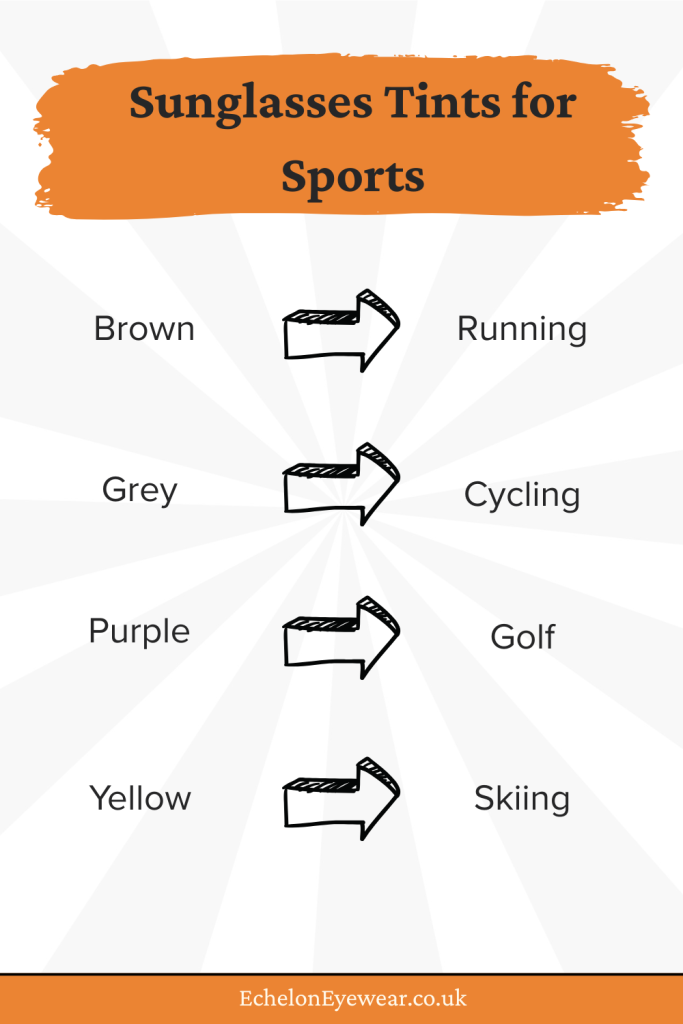
Lens tints are the colour of your lenses and how much light they allow through. The colour of your lenses might not seem like a big deal. But different colours can impact your vision and performance more than you’d expect. Pairing the right colour with the right lens technology will be key to maximising your vision and sports performance.
Brown: Good for increasing contrast and sharpness when judging distances or uneven terrain.
Grey/black: A good all-rounder that reduces light evenly.
Green: One of the best tints for reducing glare and bright sunlight.
Yellow: Enhance vision in low-light environments.
Pink/purple: Helps to dull the colour green and enhance clarity, making it ideal for golf.
Read our full guide to learn more about different sunglasses tints.
We hope this helps to break down some of the more confusing sunglasses jargon you might see when shopping. Check out our glossary page for more.