
Sunglasses come in a range of different styles these days, from lenses tints to frame style. One thing that’s often overlooked is choosing the right sunglasses category. This refers to the level of light that comes through the lens. Sunglasses categories come in five types, from category 0 to category 4.
But which sunglasses category is right for you?
What do sunglasses categories mean?
Sunglasses categories are based on something called VLT – Visible Light Transmission. This is measured as a percentage of how much light gets through the lens. The higher the VLT number, the lighter the lens.
VLT can be as low as 3-8% or as high as 80-100%. Sunglasses are categorised as one of five lens categories.
Let’s look at what each of them means and why you’d use them.
Sunglasses categories explained
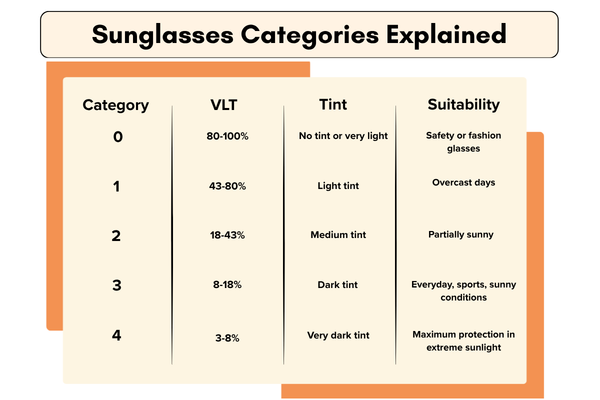
Category 0 glasses
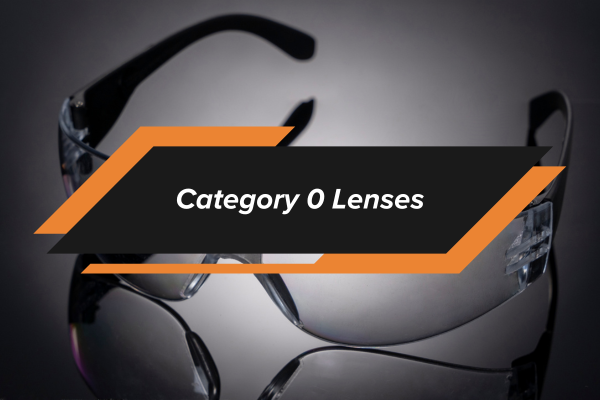
- 80-100% VLT
- No tint or very light
- For impact protection, safety glasses, or fashion purposes
Category 0 glasses aree not especially common, but are used mostly in environments where protective eyewear is key. These lenses don’t impact vision clarity but protect the eyes from impact, debris, and even UV rays. Another use for category 0 glasses is simply for fashion purposes.
Category 1 sunglasses
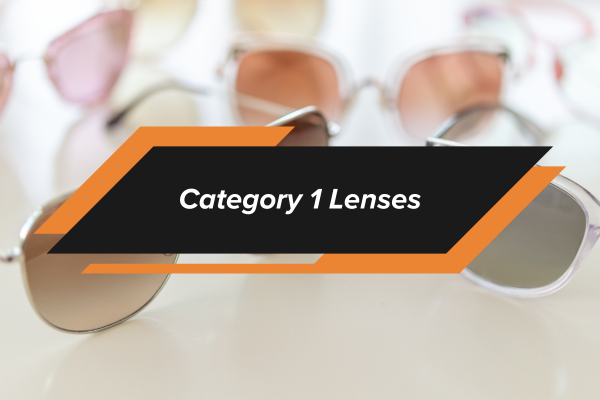
- 43-80%
- Light tint
- A pale, often yellow or rose tint
- For low-light conditions
Offering a little protection from glare, category 1 sunglasses are best suited to overcast days or simply for fashion.
Category 2 sunglasses
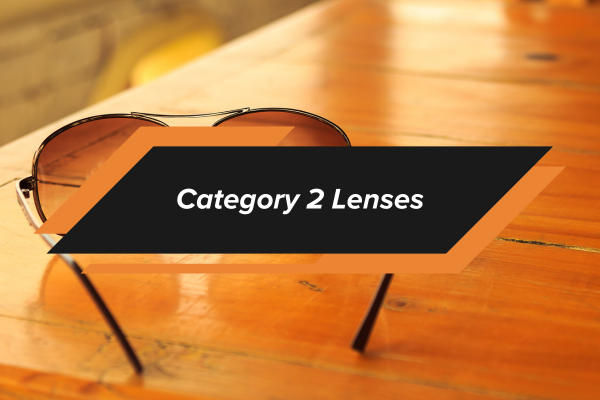
- 18-43%
- Medium tint
- Often red, orange, rose or blue lenses
- For partially sunny conditions
Best suited for partially sunny conditions, category 2 sunglasses offer some protection against glare while also maintaining good clarity. Some people prefer them in certain sports when vision or colour clarity is the top priority.
For skiing, category 2 lenses can help you to make out rough terrain that’s harder to see in flat light. These lighter lenses are also helpful for golf as they enhance depth perception and clarity when looking over distances.
Category 3 sunglasses
- 8-18%
- Dark tint
- Mostly grey or brown lenses
- For everyday uses or sports in sunny conditions
Most sunglasses you’ll come across fall into this category. Category 3 sunglasses offer a good level of protection against glare and are suitable for most conditions or activities, from everyday living to sports.
Category 4 sunglasses
- 3-8%
- Very dark tint
- Dark grey or brown
- For maximum protection in extreme sun
The darkest lens type is category 4 sunglasses. These are more suitable for extreme conditions in very bright sunlight like mountain climbing or high-altitude hiking, where glare is more intense. So you’ll likely only find category 4 lenses in sports sunglasses rather than everyday pairs.
One thing to note is that category 4 sunglasses are not suitable for driving because they’re too dark to see clearly. You could even face a fine if you wear category 4 sunglasses while driving.
Which sunglasses categories offer UV protection?
Lenses tint or colour isn’t related to the level of UV protection. UV protection works when a UV filter, which is clear in colour, is applied to lenses. So technically, even clear lenses can offer UV protection. Always be sure to check this beforehand if you’re wearing them outdoors.
Which sunglasses category do I need?
For most cases, category 3 lenses are more than suitable. They work well in sunny conditions either as an everyday pair or for sports.
If you’re going to be doing more extreme high-altitude sports when sunlight is very bright with no shade, then category 4 lenses may be best.
For low-light conditions, category 0 to 2 offer protection from UV light and reduce glare without impacting vision clarity.
The best thing to do is consider the conditions you’ll be wearing these sunglasses in and your biggest priorities. We’d always recommend going for glasses that offer UV protection if you’ll be outdoors for a while.
Do you want to learn more about different sunglasses types before you pick a pair? Check out our Sports Sunglasses Jargon Buster to learn more.